Watch Movements

Table of Contents

Understanding different Types of Watch Movements

The watch movement is the engine of every watch which makes your watch tick like a heart.

We distinguish following type of watch movements:
Movement type
Power storage
re-powered by
Power reserve
Accuracy
Servicing
Manual

in a coiled
mainspring
hand-winding
the crown
40 hrs
up to
8 days

±5 – 20
sec / day
every 4 to 10y
cleaning
+ lubrication
Automatic
a rotor which rotates when
the watch is moved
Quartz
in a battery
battery replacement
&/or
solar cell
1 to 3 years
without
solar cell

±10
sec/month

battery
replacement
Meca-Quartz
Manual-wind
Automatic, standard rotor
Automatic, mico-rotor
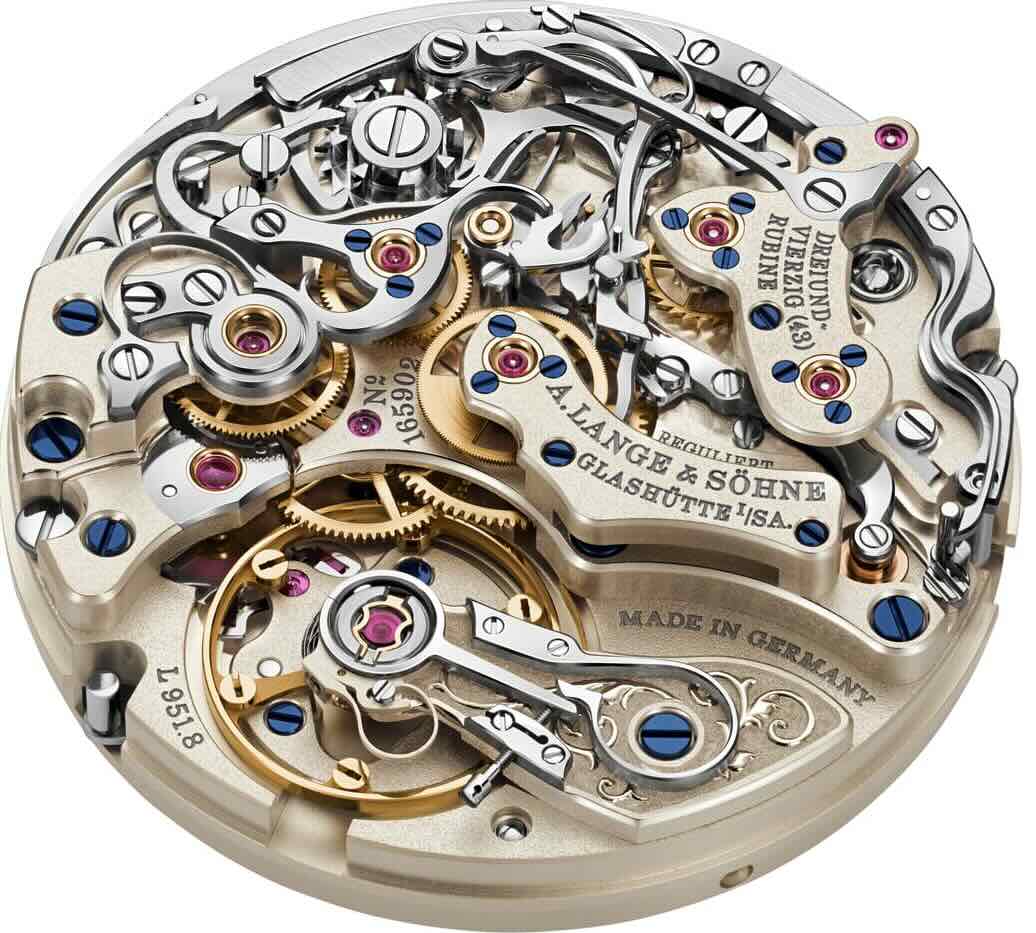
A.Lange & Sohne
L951.8 movement
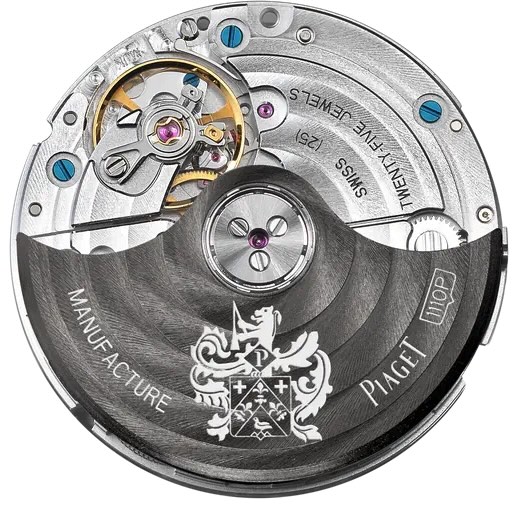
Piaget
Manufacture 1110P
Piaget
Manufacture 1255HP ultra-thin
Meca-quartz movement is a hybrid watch mechanism using a Quartz movement for time keeping, combined with a mechanical module for a chronograph providing a sweeping chronograph seconds hand

Frequency - Vibrations per hour (VPH) - Beats per second (BPS)

Frequency
VPH
BPS
Notes
2.5 Hz
18'000
5
rarely used (used by A.Lange & Sohne)
3 Hz
21'600
6
traditional
3.5 Hz
25'200
7
rarely used, (used by Longines)
4 Hz
28'800
8
most mechanical watches operate at 4 Hz
5 Hz
36'000
10
smooth sweeping second, called "High-beat"
Conversion formulas:
  VPH = BPS x 60 sec/min x 60 min/hr = BPS x 3'600 sec/hr
  Frequency (Hz) = VPH / 7200 = BPS / 2

Accuracy

Accuracy of decent mechanical watches varies from 2 up to 20 seconds per day.
Most well-known watch manufacturers will indicate the accuracy of their watch movements.
Some will have the watch movements tested and certified as high precision Chronometer.

It's relatively expensive to test and certify. A certification is a mark of high-quality and adds to the prestige.  

Accuracy fine tuning - regulator movements versus free-sprung balances

While every chronometer requires some method for fine-tuning its accuracy &/or to pass strict certification standards, watchmakers can achieve this using two completely different mechanical systems:
1. The traditional way, using regulator movements
The watch movement contains a regulator arm (a small lever over the balance wheel). Moving this lever changes the active length of the hairspring to make the watch run faster or slower.  
2. The high-end way: Free-Sprung balances
The absolute highest-tier chronometers are "free-sprung", meaning they have no regulator arm at all. The hairspring is fixed at a permanent length. To adjust the watch's speed, watchmakers adjust tiny, highly precise weights or screws directly on the rim of the spinning balance wheel &/or use lasers to make small incision adjustments to the balance wheel.
The Physics: Think of a spinning figure skater. Moving the weights inward makes the wheel spin faster; moving them outward slows it down.
Why Free-Sprung is Preferred for Chronometers
Most luxury watch brands abandon the regulator arm in their chronometers because a free-sprung system provides superior long-term precision. Without a physical lever, there is no regulator arm that can accidentally shift out of place if you drop the watch or subject it to a heavy shock. It allows the watch to hold its chronometer-certified accuracy far better over time.

Magnetic Influence

Causes temporary inaccuracy (watch runs fast), rarely permanent damage
Magnetic sources: Phones, laptops, speakers, industrial environments
Modern movements are more resistant to magnetic influence and it is thus less a major purchase differentiator
For high accuracy movements, high resistance to magnetic influence is important, resulting in need for use of anti-magnetic materials (e.g. silicone hairspring) and superior shielding.

COSC Chronometer Certified

Certifies:

  • accuracy of -4 to +6 seconds per day
  • tests conducted on the movement (not assembled in the watch case), over 12 to 20 days, in 5 positions at 3 temperatures (8°C, 23°C, and 38°C)

COSC + METAS Master Chronometer Certified

Launched in 2015

Certifies:

  • accuracy of 0 to +5 seconds per day
  • magnetic resistance able to withstand magnetic fields of > 15000 gauss without stopping
  • stated power reserve is verified
  • tests conducted on the fully cased finished watch.

COSC Excellence Chronometer Certified

Launched in February 2026

Certifies:

  • accuracy of -2 to +4 seconds per day
  • magnetic resistance at 200 Gauss
  • stated power reserve is verified
  • tests conducted on the fully cased finished watch. over 4+ days, in 6 semi-dynamic positions to simulate real-life wear

COSC non-profit association

The Contrôle Officiel Suisse des Chronomètres is a non-profit association founded in 1973 to test & certify watch movements.

In 2025, 2.1 million watches were COSC certified. 39% of exported Swiss watches were COSC certified.

60+ brands have received COSC certifications:

Albishorn, Alexandre Meerson, Ange Brade, Arnold & Son 1764, Artya Watches, Auricoste, Ball, Baume & Mercier, Bell & Ross, Bernhard H. Mayer, Breitling, Brellum, Bulgari, CB, Certina, Chanel, Chopard, Christopher Ward, Code41, Cuervo Y Sobrinos, Czapek, Delma, Doxa, Edox, Ferdinand Berthoud, Festina, Formex, Fortis, Frederique Constant, Girard-Perregaux, H992, Hamilton, Horage, IWC, Jacob&Co, Jean Marcel, Laventure, Lederer, Longines, Mido, Mont Blanc, Norqain, OW, Omega, Panerai, Parmigiani-Fleurier, Paul Picot, Perrelet, Philip Watch, Porsche Design, Rado, Rolex, Saner, Serica, Squale, Steel Standing, TAG Heuer, Tissot, Titoni, Tudor, Ultramarine, Ulysse Nardin, Vacheron Constantin, Venus Per Constantiam, Zenith, Zodiac

Rolex submits the highest number of movements, followed by Omega, Breitling, Tissot and Mido.

Complications

Complications are watch functions in addition to the basic Hour, minute, seconds watch functions.

Type of complications:

  • ICalendar: Day, Date, Month, Year, Perpetual calendar
  • Time: GMT 2nd time zone, AM/PM, 0-24 hour indication, Chronograph
  • Astronomical: Moon phase
  • Mechanical: small seconds, small hours, Power Reserve indicator, Jumping hour, Minute Repeater, Chime, Tourbillon

Benefits:

  • Additional functionality providediDay, Date, Month, Year, Perpetual calendar
  • More exclusive, statusT
  • Visually more interesting
  • appreciation for craftsmanship in being able to get additional complications engineered in a relative small case

Disadvantages:

  • More fragile: mechanism can break if handled incorrectly (e.g. change hour, calendar, moon phase when hour is between 10pm and 2am)
  • More complex to reset the watch time, date moon-phase after not having been used for a while: multiple crown settings & pushers to handle may require reconsulting the manual
  • on some perpetual calendar watches the year can not be moved backwards and as such if you accidentally set it a year ahead you have to get it serviced to move it back
  • service cost higher

Vacheron Constantin - Les Cabinotiers Solaria Ultra Grande Complication:
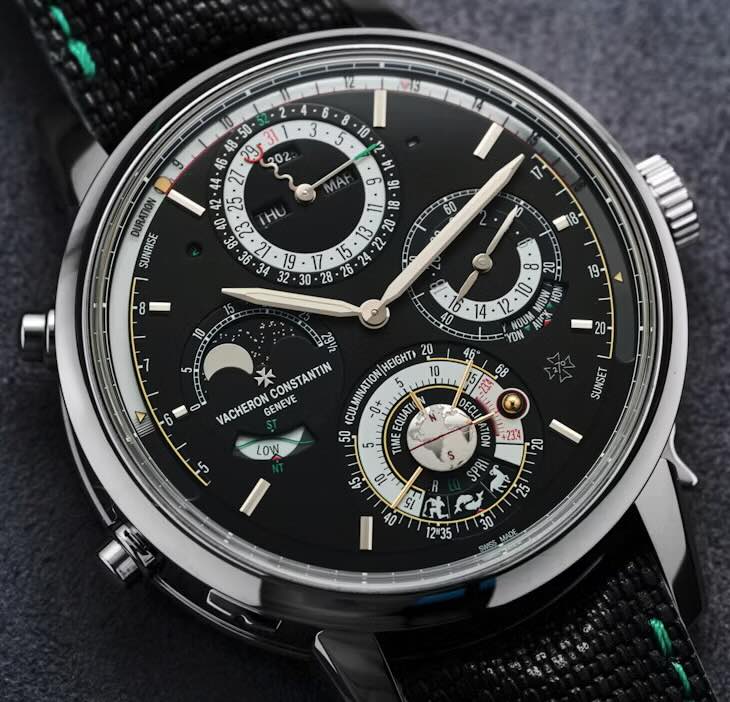
  • 41 complications, 1521 components of which 204 jewels, housed in a case of 45mm in diameter and 14.99mm thick
  • 6 Time related: Day/night, 2nd time zone, World time for 24 cities, 2nd time zone day/night indication, Tourbillon, Civil time display
  • 8 calendar: perpetual calendar, day, date, month, year, leap year indication, week number, number of day in the week
  • 3 Lunar indications: moon phase, tide level, spring and neap tide indication
  • 14 Astronomical indications: season, equinoxes, solstices, sun position, sunrise time, duration of the day, equation of time on tropical gear, culmination time of the sun, height of the sun above horizon, declination of the sun, 3D Earth showing latitude of the sun in N/S hemisphere, Sidereal hours, Sidereal minutes, zodiac signs, sky chart, temporal tracking of celestial objects
  • 6 mechanical: minute repeater, Westminster carillon chime (4 hammers + 4 gongs), choice of hour-only or full chime, crown locking system during chiming, double-stop hammer system to limit rebound and optimize hammers' kinetic energy, Power reserve indicator
  • 4 Chronograph: chronograph, 60-minute counter, split-seconds chromo, isolator system for split-seconds chronograph.

Made in Switzerland versus alternative strong countries

A "Swiss Made" label on a watch is an endorsement of quality, know-how, reliability, value. With a tradition in watch making, which originated well before 1900, centralised in Switzerland and with several watch-making schools, competition, variety and volume of mechanical watches designed, engineered and produced in Switzerland there is a clear dominance over other countries.

For a watch to be able to have a "Swiss made" label it must meet following criteria:
  - house a Swiss watch movement
  - be assembled in Switzerland
  - at least 60% of production cost incurred in Switzerland.
This implies some work or parts of a watch can be produced elsewhere (e.g. straps, case, ...)

Other countries with strong offerings in high quality watches:
  -
Germany (A.Lange & Sohn, Glashütte Original, Nomos, Sinn)
  - Japan (Grand Seiko, Seiko, Citiz
  - France (Baltic, Yema)
  Emerging: China (improving rapidly)

Several watch brands originated outside Switzerland for its watch concept, design, marketing etc, but have -for all or some watches-, the movement, assembly and >60% of production in Switzerland in order to benefit from "Swiss Made" label on the watch. (Examples: Panerai, Baltic, Bremont, Farer, Studio Underd0g, Yema)

Mass industrial watch movements versus in-house manufacture

High-end watch brands (Patek Philippe, Rolex, Jaeger-Lecoultre, IWC, A.Langhe & Sohn, Glashutte Original, Grand Seiko, ...) have their watch movements developed and produced in house ("in-house manufacture").

Many mid to high-end watch brands source their watch movements from high quality Swiss watch movement manufacturers like Sellita, ETA SA, La Joux-Perret, Kenissi. Sellita currently offers 225 different watch models, most of which can be obtained 5 different decoration finishing levels (D1 - none, D2 - simple, D3 - refined, D4 - luxurious, TAI - Tailor-made)
  Some brands enhance those movements and then stick their own movement reference to it, but indicate which industrial movement it is based on (e.g. based on a SW200-1 Sellita movement)

Many entry-level to mid-end watch brands source their watch movements from decent Japanese watch movement manufacturers like Miyota or Seiko.
  Some can fine-tune the watch accuracy precision and provide an accuracy measure extract  

Some lower entry-level watch brands source their watch movements from Chinese watch movements manufacturers.
  Some will indicate whether the model is copy based on a more famous (Sellita) model

© 2026 ShowMeYourWatch - All rights reserved.`
Terms of Use
Privacy Policy
Cookie Policy